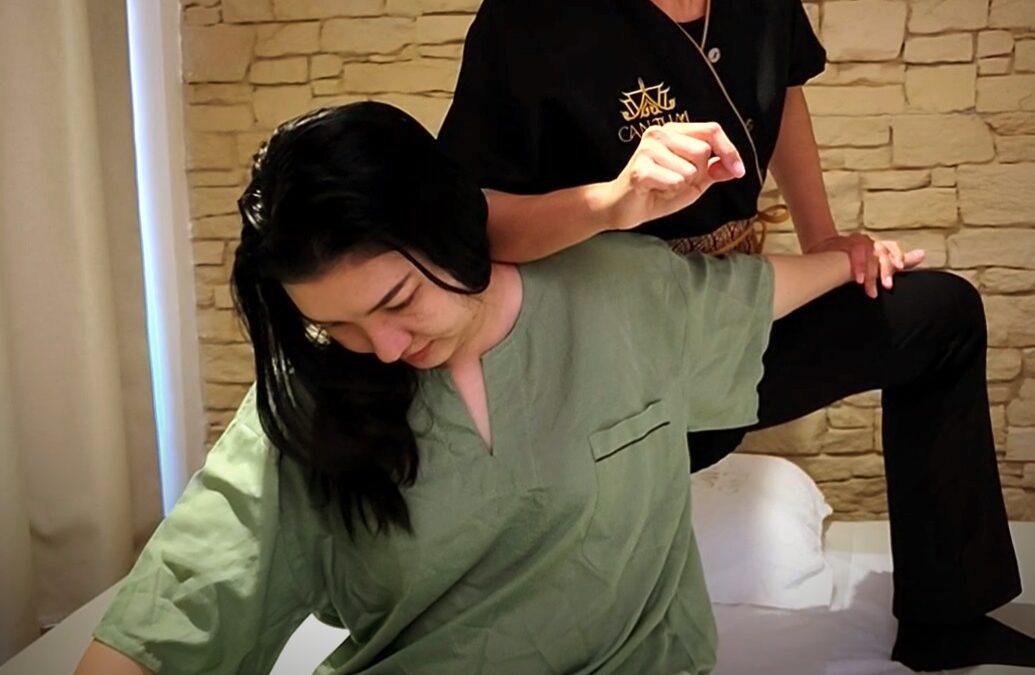
Thai massage improves flexibility through passive assisted stretching — the masseuse moves your body through a full range of postures while your muscles remain completely relaxed. Unlike self-stretching, this bypasses the stretch reflex, allowing deeper lengthening of muscles and fascia than you can achieve on your own [1]. Most people feel a measurable difference in their range of motion after a single 60–90 minute session. No flexibility or yoga experience is needed. At Can Thai Massage Ibiza, our native Thai masseuses in Sant Miquel apply this technique daily to clients of all fitness levels and ages.
Why is Thai massage so effective for improving flexibility?
Thai massage stretching works because it is passive — your muscles are not contracting to produce the movement. This switches off the stretch reflex, the protective mechanism that normally prevents muscles from lengthening beyond a certain point. With that barrier removed, the masseuse can take your joints and tissues into a deeper, more productive range than you could ever achieve alone [1][2].
When you stretch by yourself, your nervous system detects the lengthening and triggers the stretch reflex to pull back. This is a protective response, but it also sets a ceiling on how flexible you can become through solo practice alone. Thai massage bypasses this entirely. Because your body is completely passive and supported, the nervous system does not fire the same protective signal — which is why the gains in range of motion from a single Thai massage session can be immediate and noticeable [2].
There is also a fascial component. The sustained, rhythmic compression and stretching applied during a Thai massage session helps rehydrate and mobilise the fascia — the connective tissue that wraps every muscle and joint in the body. When fascia becomes dehydrated or restricted through inactivity, stress, or repetitive movement patterns, it limits flexibility independently of the muscles themselves. Thai massage addresses both layers simultaneously [3].
Which areas of the body gain the most flexibility from Thai massage?
The hips, lower back, hamstrings, thoracic spine, and shoulders are the areas where most people carry the greatest restriction — and where Thai massage produces the most dramatic flexibility gains in a single session. These are also the regions most affected by sedentary lifestyles, desk work, and travel.
Hips and hip flexors
The hip flexors are among the most chronically tight muscles in modern adults, shortened by hours of sitting and rarely stretched through a full range in everyday movement. Thai massage includes specific postures that open the hip joint in multiple planes — forward, lateral, and rotational — producing a release that most people have never experienced through self-stretching alone.
Hamstrings and lower back
Tight hamstrings are one of the primary contributors to lower-back tension and poor posture. Thai massage addresses the entire posterior chain — from the base of the skull to the heels — as a connected unit, releasing the interconnected tension between the lumbar spine, sacrum, and leg muscles in a way that isolated stretching cannot replicate [4].
Thoracic spine and shoulders
The upper back and shoulder girdle are areas where postural restriction accumulates quietly over years. Thai massage includes seated and supine postures that open the chest, mobilise the thoracic vertebrae, and release the rotator cuff — restoring a freedom of movement in the upper body that many clients describe as something they had not felt since childhood.
Neck and cervical spine
Neck mobility is rarely addressed adequately in standard exercise routines. Thai massage includes gentle traction and rotation of the cervical spine, significantly improving lateral and rotational range of motion and relieving the compression that builds up from screen use and poor head posture.
Can you really feel more flexible after just one session?
Yes — and it is one of the most consistent feedback points from our clients at Can Thai Massage Ibiza. The combination of passive stretching, acupressure, and fascial release in a single session produces an immediate and tangible change in how the body moves and feels. Research on Thai massage confirms significant improvements in flexibility and joint range of motion after a single session [2].
The immediacy of the effect comes down to three simultaneous mechanisms happening within the session:
- Neuromuscular release — the nervous system learns, within the session, that deeper ranges of motion are safe. This recalibration happens in real time as the masseuse progressively works through the body.
- Fascial hydration and mobilisation — sustained pressure and movement stimulate the production of synovial fluid in joints and increase the water content in fascial tissue, both of which directly improve tissue extensibility [3].
- Reduction of protective muscle tension — acupressure on trigger points releases chronic holding patterns in muscles, allowing the surrounding tissue to lengthen more freely during the stretching sequences that follow.
The gains from a single session are real, but they are also cumulative. With regular Thai massage — every 4–6 weeks — the body progressively establishes new baseline ranges of motion that become permanent rather than temporary.
What makes Thai massage stretching different from stretching on your own?
The key difference is the complete absence of muscular effort on your part. When you stretch alone, the target muscle must simultaneously relax and stabilise the posture — which creates an inherent conflict that limits depth and duration. In Thai massage, the masseuse holds, supports, and moves your body entirely, allowing 100% of your attention and muscular energy to go into releasing.
Beyond the neuromuscular mechanics, there are practical differences that make Thai massage stretching consistently more effective than solo practice for most people:
- External load and gravity — a skilled masseuse can apply body weight and leverage to achieve joint positions that are physically impossible to reach alone.
- Three-dimensional movement — Thai massage sequences move each joint through multiple planes in coordinated patterns, replicating the complexity of real movement rather than the single-plane isolation of most static stretches.
- Sequencing and preparation — the masseuse warms up the tissue with compression before each stretch, making the muscle more receptive to lengthening and reducing the risk of the stretch reflex firing.
- Full-body integration — rather than stretching one muscle in isolation, Thai massage addresses the body as a connected kinetic chain, which produces functional flexibility that translates directly into how you move in everyday life.
For this reason, Thai massage is particularly valued by athletes, dancers, and active people — not as a replacement for their regular training, but as a way to unlock ranges of motion that training alone cannot access. At Can Thai Massage Ibiza, we regularly work with runners, surfers, and cyclists visiting Ibiza who use our sessions as an integral part of their recovery and performance routine. Learn more about our approach on our About Us page or contact us with any questions.
Experience the stretching benefits of Thai massage for yourself in Ibiza.
→ Book Your Session at Can Thai Massage Ibiza
Frequently Asked Questions about Thai Massage Stretching Benefits
Do I need to be flexible before receiving Thai massage?
Not at all. Thai massage is designed precisely for people who are not flexible. The masseuse does all the work — you simply lie still and receive the session. People who are stiff, sedentary, or recovering from physical inactivity often experience the most dramatic improvements in a single session.
How does Thai massage improve flexibility faster than regular stretching?
Because the stretching is completely passive, your nervous system does not trigger the stretch reflex — the protective mechanism that limits how far muscles can lengthen. With the stretch reflex bypassed, the masseuse can take your body into deeper ranges of motion than you can access alone, producing faster and more significant flexibility gains [1].
Which body areas does Thai massage stretch the most?
Thai massage works the entire body as a connected unit, but the most noticeable flexibility improvements are typically felt in the hips, hamstrings, lower back, thoracic spine, and shoulders — the areas where most people carry the greatest chronic restriction from sitting, travel, and daily posture habits.
How long do the flexibility improvements from Thai massage last?
After a single session, most people notice improved mobility for several days. With regular sessions — every 4–6 weeks — the body progressively establishes new baseline ranges of motion that become permanent rather than temporary. Clients who visit us consistently during their time in Ibiza report cumulative and lasting improvements with each session.
Is Thai massage good for people who sit at a desk all day?
It is one of the best options available for desk workers. Prolonged sitting shortens the hip flexors, compresses the lumbar spine, rounds the thoracic spine, and tightens the hamstrings — exactly the areas that Thai massage targets most directly. A single session can undo weeks of accumulated postural restriction.
Can athletes use Thai massage to improve their performance?
Yes. Thai massage is widely used in professional sport for its ability to restore range of motion, reduce muscle tightness, and improve joint mobility between training sessions. Improved flexibility through Thai massage stretching translates directly into better movement efficiency, reduced injury risk, and faster recovery.
Does Thai massage hurt when it stretches you?
Thai massage should never be painful. You may feel a deep, productive sensation in areas of high tension — similar to the feeling of a good stretch — but the masseuse always works within your comfort range and adjusts immediately to your feedback. Communication throughout the session is always encouraged.
How is Thai massage stretching different from yoga?
In yoga, you actively produce each posture using your own muscular effort, which means the muscles must simultaneously contract and relax — limiting how deeply you can stretch. In Thai massage, the masseuse moves and supports your body entirely, so your muscles can let go completely. This passive quality allows for deeper, faster flexibility gains with no effort required on your part.
Sources
- Wiktorsson-Möller, M. et al. (1983). Effects of Warming Up, Massage, and Stretching on Range of Motion and Muscle Strength in the Lower Extremity. The American Journal of Sports, 11(4), 249–252. doi.org/10.1177/036354658301100408
- Chatchawan, U. et al. (2014). Effects of Thai Traditional Massage on Physical Fitness in Football Players. Medical Science Monitor, 20, 1830–1836. doi.org/10.12659/MSM.890816
- Schleip, R. & Müller, D.G. (2013). Training Principles for Fascial Connective Tissues. Journal of Bodywork and Movement Therapies, 17(1), 103–115. doi.org/10.1016/j.jbmt.2012.06.007
- Buttagat, V. et al. (2016). Effects of Thai Traditional Massage on Chronic Nonspecific Low Back Pain. Journal of Bodywork and Movement Therapies. doi.org/10.1016/j.jbmt.2015.11.010
About Can Thai Massage Ibiza
This article was written by the team at Can Thai Massage Ibiza, a family-run Thai massage centre of Thai origin located in Sant Miquel, Ibiza. All our masseuses are native Thai and certified by Thailand’s most prestigious massage schools. We apply passive Thai stretching techniques daily to clients of all ages and fitness levels — from first-timers to professional athletes.